
Development guide · Malta & Gozo
Archaeological monitoring in Malta: what development teams need to know.
A practical guide to when monitoring is required, who may carry it out, how the Superintendence of Cultural Heritage process works, and how to plan excavation, discoveries, reporting and close-out.
For developers, property owners, periti and contractors planning ground disturbance.
The short answer
Check the permit before programming excavation.
Archaeological monitoring is required when it is imposed by the relevant permit, written authorisation or direction. It is commonly associated with ground-disturbing work where archaeological remains may survive.
If a condition applies, the development team normally appoints a registered archaeologist, obtains project-specific approval and Terms of Reference from the Superintendence of Cultural Heritage (SCH), and coordinates the archaeologist’s attendance before covered works begin.
Important: not every excavation automatically requires a monitor. The exact permit condition and SCH instructions control the scope. If the wording is unclear, resolve it before mobilisation rather than relying on assumptions made on site.
What it is
A controlled watching brief during development works.
Archaeological monitoring is the professional observation of development work that could expose, disturb or affect cultural-heritage remains. Malta’s present statutory framework dates from the Cultural Heritage Act 2002, which established the SCH as the cultural-heritage regulator and assigned it responsibility for monitoring and heritage safeguards within development planning.
This places the SCH within the planning process where proposed development may affect heritage assets. Archaeological monitoring is one way that protective role is implemented when required by the applicable permit and SCH Terms of Reference.
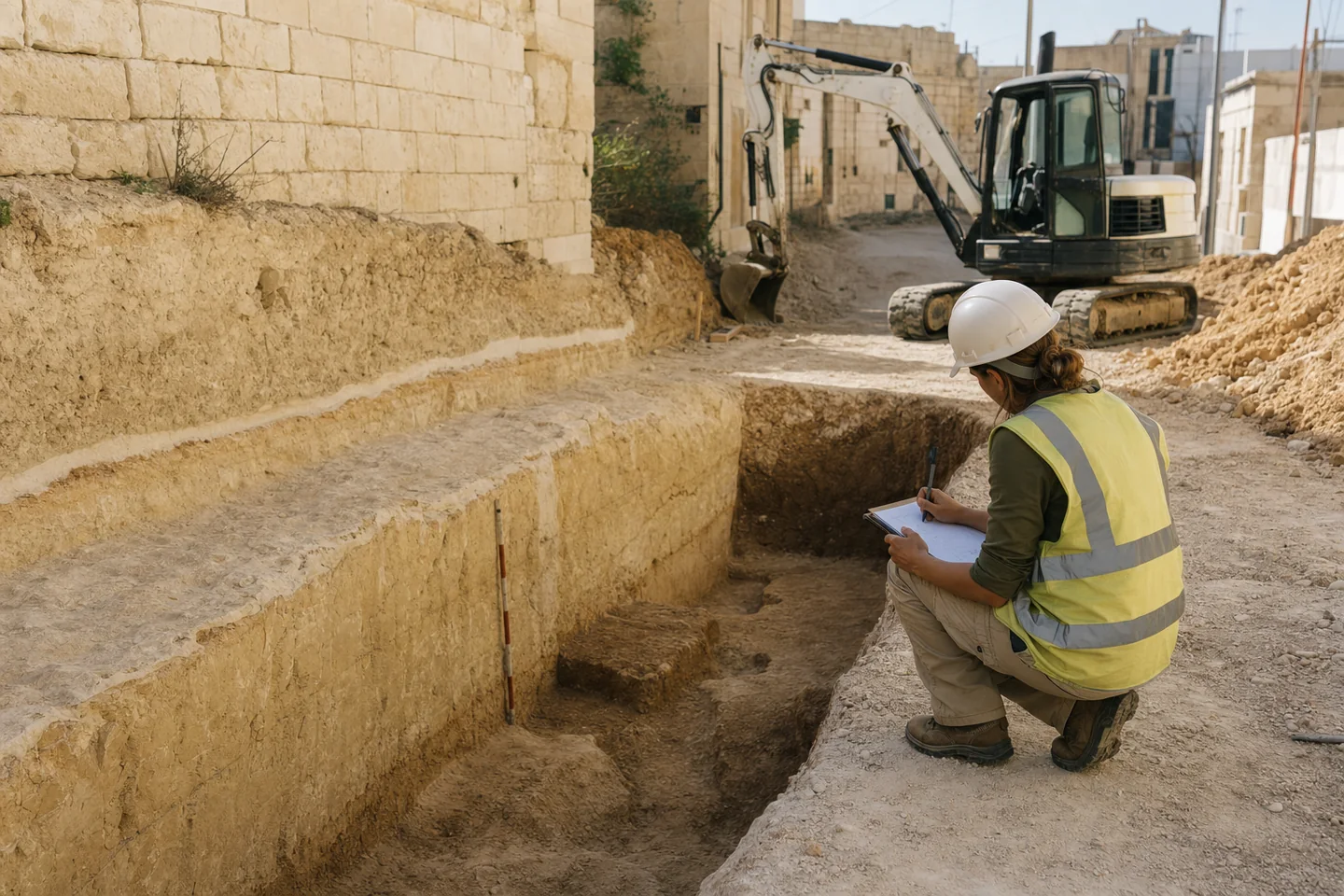
The archaeologist works alongside the construction sequence. They inspect exposed deposits and features, keep the required field record, communicate with the site team and notify the SCH when something requires direction. The objective is to identify and safeguard evidence without treating every project as a full archaeological excavation.
Monitoring may cover machine excavation, reduction of levels, removal of floors or fill, foundation and service trenches, rock cutting, demolition that exposes earlier fabric, or another activity identified in the Terms of Reference. The monitored activity and attendance level are project-specific.
Monitoring
Observes development-led works and responds to archaeology as it is exposed.
Evaluation
Investigates archaeological potential before or during a planning decision.
Excavation
Systematically investigates and records remains under an approved methodology.
A discovery during monitoring can lead to a more intensive investigation, but only under the appropriate SCH direction and authorisation.
When it is required
The permit decides. Site sensitivity explains why.
The SCH is Malta’s statutory cultural-heritage consultee in the planning process. It can recommend heritage conditions where proposed work may affect sites, structures, objects or landscapes of cultural value.
A permit condition
The clearest trigger is an archaeological-monitoring condition in a Planning Authority or other works permit.
An archaeologically sensitive context
Proximity to known or scheduled remains, historic urban fabric or a landscape with recorded archaeological potential can influence the requirement.
Ground disturbance
Basements, pools, foundations, service runs, road works and level reductions can affect deposits that were previously sealed.
Known or suspected features
Existing masonry, rock-cut features, old wells, earlier floors, soil deposits or prior discoveries may justify closer archaeological control.
A pre-decision requirement
The authorities may seek an archaeological evaluation or other investigation to inform planning before a final development decision.
Read the whole condition
Confirm the covered activities, notice period, named contacts, required submissions and the point at which written clearance is needed.
Send us the conditionSilence is not a substitute for due diligence where known remains or an unexpected discovery are involved.
Do not schedule covered works until the archaeologist, SCH approval and Terms of Reference are coordinated.
Ask the project perit and a registered archaeologist to resolve the scope with the SCH before work starts.
Core requirements
What must be in place before monitored works.
Exact requirements vary. These are the recurring controls to check against the permit and project-specific Terms of Reference.
A registered, project-approved archaeologist
The SCH maintains the Register of Permitted Archaeologists. Registration alone is not the whole step: the archaeologist must also be approved or authorised for the specific project.
Written authorisation and Terms of Reference
The Terms of Reference set the site-specific scope, attendance, methods, communications and documentation. The permit may prohibit covered works before these are issued.
A coordinated sequence and safe access
The archaeologist needs notice of the programme, access to observe the relevant faces and deposits, and the ability to communicate with the operator and site manager. Archaeology does not replace the contractor’s health-and-safety duties.
Field records and timely submissions
Photographs, notes, measured information, surveillance data sheets, discovery notifications and progress or final reporting must meet the applicable SCH standard.
Protection and escalation arrangements
The team must know how to pause the affected activity, secure exposed remains and obtain SCH direction without disturbance or loss of context.
The process
From permit review to archaeological close-out.
Early coordination keeps the heritage workstream aligned with the perit, contractor and excavation programme.
-
01
Review the project documents
Read the permit, approved drawings, SCH correspondence and any existing heritage studies. Identify exactly which works are controlled.
Output · confirmed scope and missing information -
02
Appoint the archaeologist early
Select a person on the SCH register who can take responsibility for the project. Share the permit, plans, site location and expected start date.
Output · project appointment and authority submission -
03
Obtain authorisation and Terms of Reference
The SCH reviews the project and defines the requirements. Notice periods vary, so use the wording in the permit rather than assuming an immediate start.
Output · written project controls -
04
Brief the site team
Coordinate the archaeologist’s attendance with the method and sequence of work. Confirm communication, access, machinery requirements and the stop-and-protect procedure.
Output · workable monitoring plan -
05
Monitor the covered works
The archaeologist observes exposed ground and fabric, directs the archaeological response within their remit, and records progress in the required format.
Output · continuous field record -
06
Manage discoveries
If potential remains appear, protect the affected area, notify the SCH and follow its direction. A discovery may require more recording, controlled investigation or a works method statement.
Output · documented, authorised response -
07
Report and close out
Compile the site record and submit the required progress and final documentation. Completion of construction activity is not automatically archaeological close-out.
Output · final submission and applicable clearance
What gets recorded
The value is in the context, not only the object.
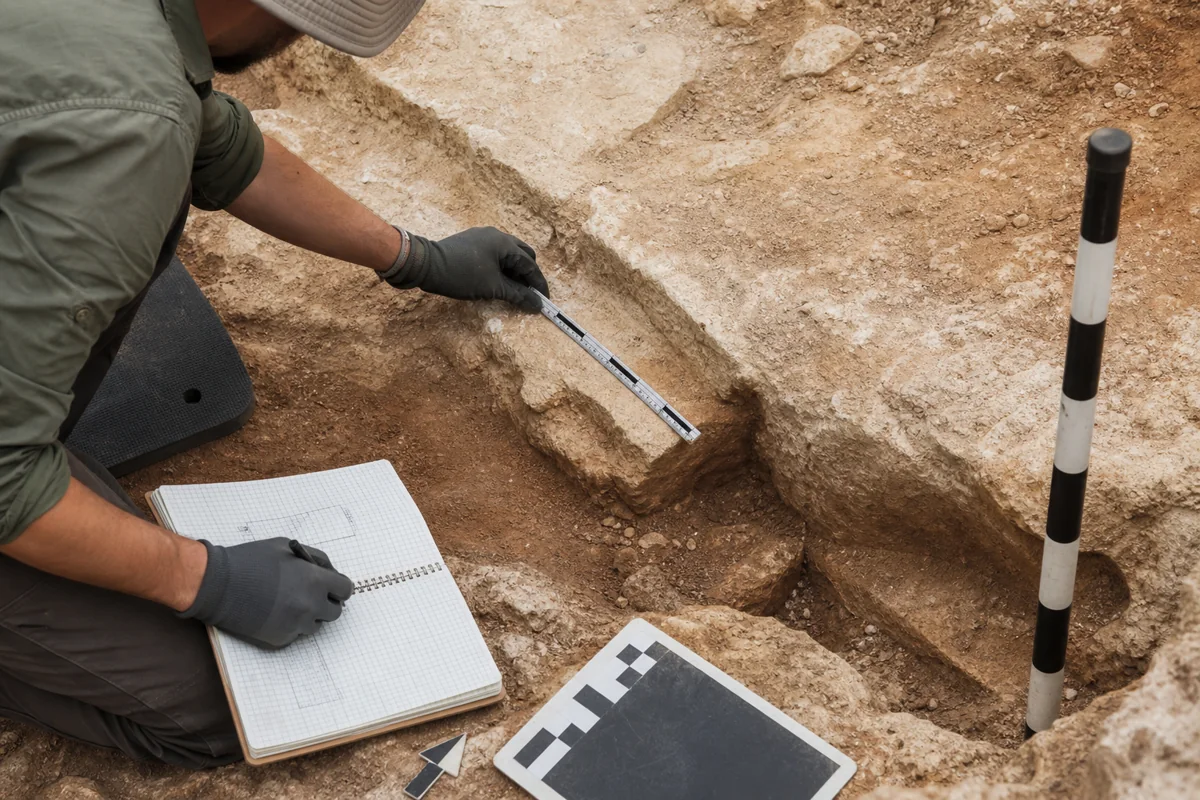
Archaeological evidence is meaningful because of where it was found, how it relates to surrounding layers and structures, and how the site changed over time.
- the location, level and extent of monitored work;
- the sequence of soil, fill, bedrock and structural remains;
- scaled photographs, notes, drawings or survey information;
- finds and samples, where collection is authorised and required;
- communications, instructions and the progress of the development works.
The SCH retains the formal archaeological documentation produced through monitoring. Data and cultural-heritage material are handled under its direction.
If remains are found
Stop the affected activity. Protect the evidence. Escalate promptly.
A discovery does not automatically mean the whole development stops indefinitely. It means the affected area must be controlled while the archaeological significance and appropriate response are established.
-
01
Pause and protect
Stop machinery or manual work where it could damage the potential remains. Keep the feature in place and prevent access or loading over it.
-
02
Do not investigate informally
Do not pull out objects, clean the feature aggressively or enlarge the exposure. These actions can destroy the relationships needed to interpret it.
-
03
Notify through the proper route
The project archaeologist records and informs the SCH in line with the Terms of Reference. If no archaeologist is appointed, inform the perit and use the SCH accidental-discovery channel promptly.
-
04
Follow written direction
The SCH may require documentation, further controlled investigation, protection in situ, a revised works method or another proportionate measure before the affected work resumes.
Who does what
A shared site process with distinct responsibilities.
The archaeologist manages the archaeological record and liaison. They do not take over the perit’s, contractor’s or site manager’s duties.
Programme & cost
Most avoidable delays begin before the archaeologist reaches site.
The developer normally bears the cost of monitoring. Total effort depends on the scope and duration of ground disturbance, access, discoveries, specialist needs and reporting—not simply the size of the building.
Send complete information
Provide the permit, approved plans, sections, excavation levels, programme, access details and all SCH correspondence at appointment.
Build in the notice period
Do not treat authority authorisation as a same-day site booking. Follow the notice requirement in the permit and allow for queries.
Sequence exposed work
Agree logical stages that can be observed and recorded safely. Avoid opening more ground than the team can protect or review.
Keep reporting current
Timely field records and submissions reduce the risk of an administrative gap between physical completion and archaeological close-out.
Before the excavator arrives
- Permit and approved drawings reviewed
- Registered archaeologist appointed
- SCH project approval confirmed
- Terms of Reference received
- Covered works and sequence identified
- Site access and safety briefing arranged
- Discovery escalation route understood
- Reporting and close-out allowance agreed
Common questions
Archaeological monitoring FAQs.
These answers describe the usual framework. Always follow the wording issued for the particular project.
Is archaeological monitoring required for every excavation in Malta?
No. The controlling documents are the applicable permit conditions, written authorisation and any project-specific Terms of Reference issued by the SCH. Ground disturbance in an archaeologically sensitive context is more likely to attract a monitoring condition, but every project must be checked on its own documents.
Who can carry out archaeological monitoring?
A competent person registered with the SCH and approved or authorised for the particular project. The current SCH register should be checked rather than relying on an old list.
Can works start before the Terms of Reference are issued?
Where a permit condition requires monitoring, covered works should not start until the required written authorisation and Terms of Reference are in place. Follow the exact condition, including any advance-notice requirement.
Does the archaeologist need to be present all day?
Attendance follows the Terms of Reference and actual sequence of controlled works. Some projects require constant observation during all ground disturbance; others may be staged. The contractor should not proceed with covered work when required monitoring is unavailable.
What happens if remains are found?
The affected work area is protected and disturbance is paused. The archaeologist records the discovery, informs the SCH and follows its direction. The response may range from additional documentation to controlled investigation, preservation or a revised works method.
Who pays for monitoring?
The SCH Operating Procedures and Standards for Archaeology Services state that the developer covers the cost of archaeological monitoring. Obtain a scope that also addresses likely reporting and possible follow-on requirements.
How long does monitoring take?
It usually follows the ground-disturbing work covered by the Terms of Reference. Duration depends on the excavation sequence, site conditions, discoveries, reporting and the time needed for regulatory direction or close-out.
Is monitoring the same as an archaeological excavation?
No. Monitoring observes development works to identify and safeguard remains. If significant archaeology is exposed, the SCH may require a controlled excavation or another investigation under an approved method.
What if something is found where no monitor was required?
Stop disturbing the affected area, protect the evidence and report the potential discovery promptly. Do not remove or clean objects or features. Inform the project perit and contact the SCH through its accidental-discovery route.
Authoritative references
Check the current official documents.
This independent guide provides general information only. It is not official guidance issued or endorsed by the Superintendence of Cultural Heritage, Planning Authority or another public authority; it is not legal advice and has no legally binding effect. Applicable legislation, permit conditions, Terms of Reference and written authority directions always prevail. Requirements and official documents can change, so obtain project-specific professional advice where required.
Start with the condition
Need archaeological monitoring for a project in Malta or Gozo?
Send the project location, permit condition, approved drawings and expected programme. ArkeoMalta can review the requirement, coordinate the process and carry the archaeological workstream through reporting and close-out.